
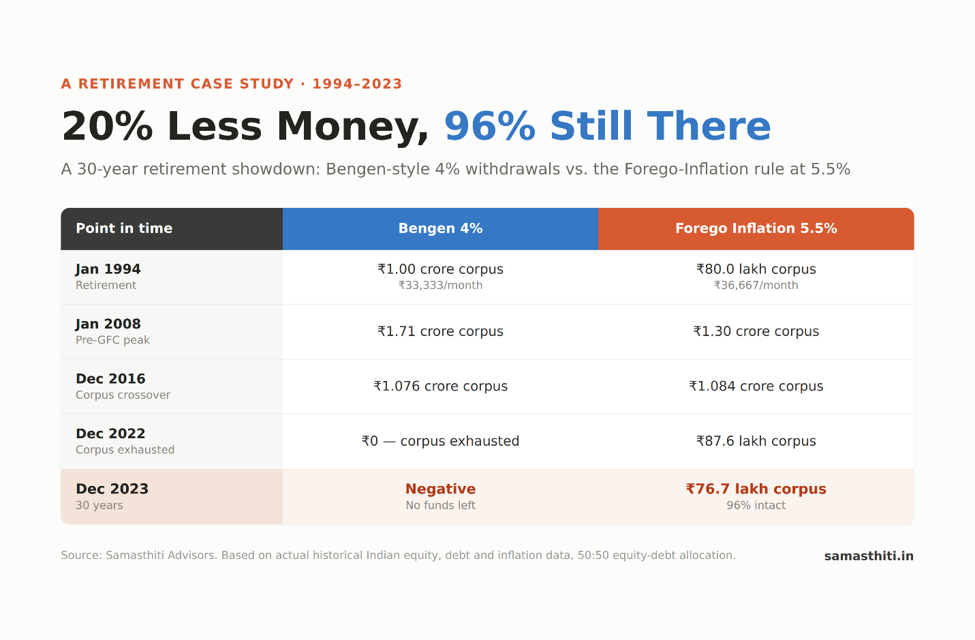
This post is based on our research study titled Boosting Retirement Income through Dynamic Withdrawals. It builds on our earlier post The Forego-Inflation Withdrawal Strategy: A Simple Tweak That Could Save Your Retirement by comparing the typical 4% withdrawal rule against the forego inflation rule. We use actual historical data to trace the experience of two retirees who are using these withdrawal strategies and compare their outcomes.
In January 1994, Arjun and Kavita retire in the same week after long careers. Both are 60 and walk into their advisors’ office with a straightforward question checking how much can I withdraw each month without running out of money?
Arjun has saved a retirement corpus of ₹1 crore. He wants predictability above all else, so he picks the classic Bengen-style approach, often called the "4% rule." He will withdraw 4% of his corpus in year one, and raise that amount every year by inflation, no matter what the market does. This is the static, constant inflation-adjusted approach we described here (and not to be confused with the fixed percentage withdrawal method).
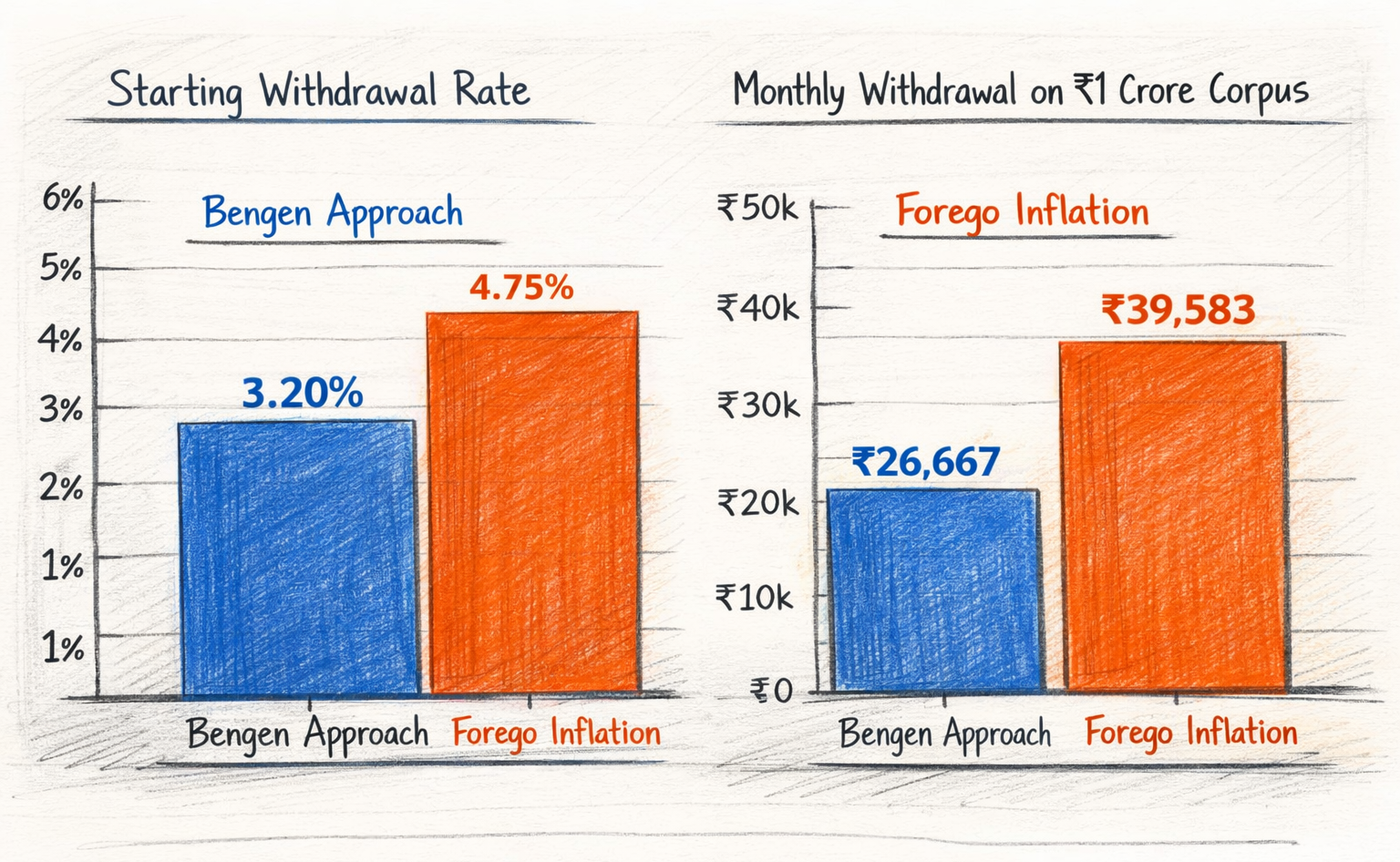
Kavita has saved ₹80 lakh, which is 20 percent less than Arjun. She is more anxious about depleting her smaller corpus and picks the forego-inflation rule instead. She will withdraw 5.5% in year one, and take the inflation raise every year that the portfolio has grown but skip it in any year it hasn't. Since the forego-inflation approach is a dynamic withdrawal strategy, it allows Kavita to target a higher initial withdrawal rate (5.5% vs Arjun’s 4% initial withdrawal rate).
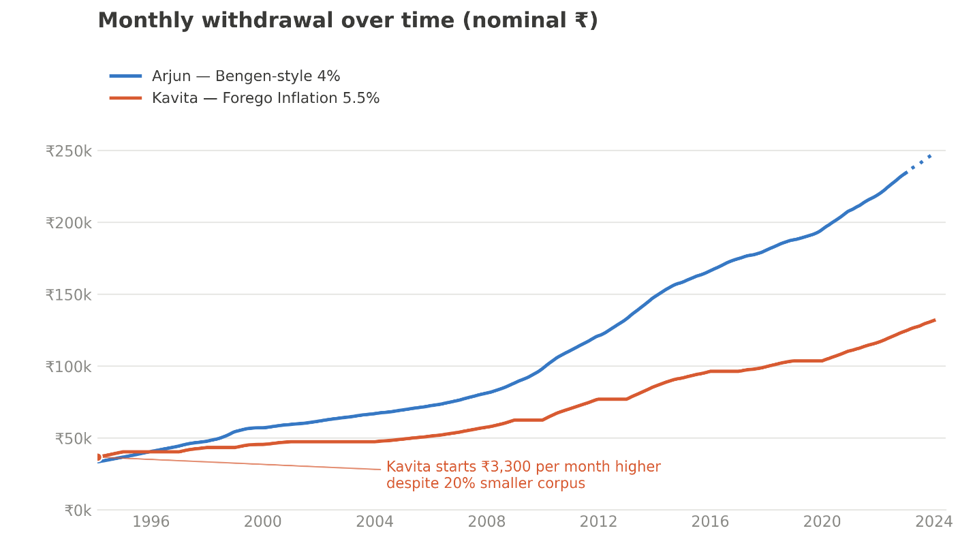
Here is the first surprise. Even though Kavita's corpus is ₹20 lakh smaller, her higher withdrawal rate means she starts with a bigger paycheck. Arjun draws ₹33,333 a month in year one. Kavita draws ₹36,667 — about ₹3,300 a month more, even though her retirement corpus is smaller.
Thirty years, the same markets
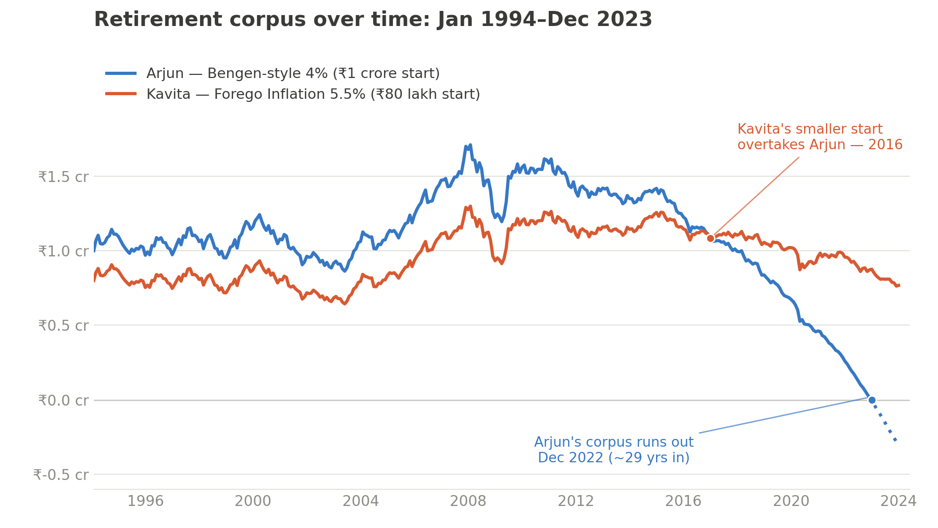
Both portfolios are invested in a 50:50 mix of equity and debt, rebalanced monthly, and run through the actual sequence of Indian equity, debt and inflation data from January 1994 to December 2023. This is not a simulation, but what really happened. Both retirees live through the same Asian Financial Crisis of 1997, dot-com bust of 2000, the 2003–2007 bull run, and the 2008 global financial crisis. By January 2008, both portfolios are near their highest. Arjun's corpus has grown to ₹1.71 crore, Kavita's to ₹1.30 crore.
From there, the paths quietly diverge. Because Arjun's withdrawals rise with inflation every single year regardless of how his portfolio is doing, his corpus faces more stress during market falls. Kavita's rule, by skipping the inflation raise whenever her portfolio has slipped, is gentler on her corpus precisely when it can least afford to be stressed.
Source: Samasthiti Advisors. Based on the actual historical sequence of Indian equity, debt and inflation data, January 1994–December 2023, 50:50 equity-debt allocation, rebalanced monthly. Dotted blue segment shows the corpus continuing to be drawn down on paper after it has already run out — illustrative only, not real spendable money
The gap shows up first not in a crash, but in a slow bleed. By December 2016, Kavita's corpus, which started ₹20 lakh behind, has quietly overtaken Arjun's corpus. From that point on, Kavita is never behind again.
The ending is stark. Arjun's corpus, after nearly three decades of full inflation-adjusted withdrawals, crosses zero in December 2022, about 29 years into his retirement. While Arjun’s corpus nearly stretches for the full 30 years, it flirts dangerously close to zero in the penultimate year, causing significant stress to him when he is roughly 89 years old.
Kavita, on the other hand, closes out December 2023 with ₹76.7 lakh still in her account — 96% of the ₹80 lakh she started with, after thirty full years of withdrawals. Kavita’s impressive ending balance allows her to protect herself against longevity risk as well as plan a bequest.
The other side of the coin: what Kavita gave up
None of this means the forego-inflation rule is a free upgrade. Because Kavita skips her inflation raise so often, her nominal withdrawal grows far more slowly than Arjun's. In fact, Arjun's monthly withdrawal overtakes Kavita's within two years of retiring — by December 1995, both are drawing about ₹40,400 a month, and Arjun only pulls further ahead from there.
Source: Samasthiti Advisors. Nominal (not inflation-adjusted) monthly withdrawal amounts. Dotted blue segment shows withdrawals that are no longer fundable once Arjun's corpus is exhausted from December 2022.
By the end of the 30 years, Arjun's withdrawal has grown 7.4-fold in nominal terms, from ₹33,333 to ₹2,47,868 a month, while Kavita's has grown only 3.6-fold, from ₹36,667 to ₹1,31,688. Over the full three decades, Arjun's plan called for withdrawing a nominal total of about ₹4.08 crore versus Kavita's ₹2.54 crore.
But that comparison flatters Arjun's numbers more than his actual retirement did. Roughly the last thirteen months of his withdrawals were never really available. His corpus had already run out, so those later, larger figures are what full inflation-indexing would have demanded of a portfolio that no longer existed, not money he could actually spend. Kavita's withdrawals, smaller and slower-growing as they are, were real and funded in every single month of the 30 years.
What this one retirement actually tells us
This is a single historical sequence, not a statistical average. It shows what would genuinely have happened to someone unlucky (or lucky) enough to retire in January 1994, rather than a Monte Carlo simulation across thousands of possible futures. We use it because a single lived sequence makes sequence-of-returns risk concrete in a way that percentiles and averages don't.
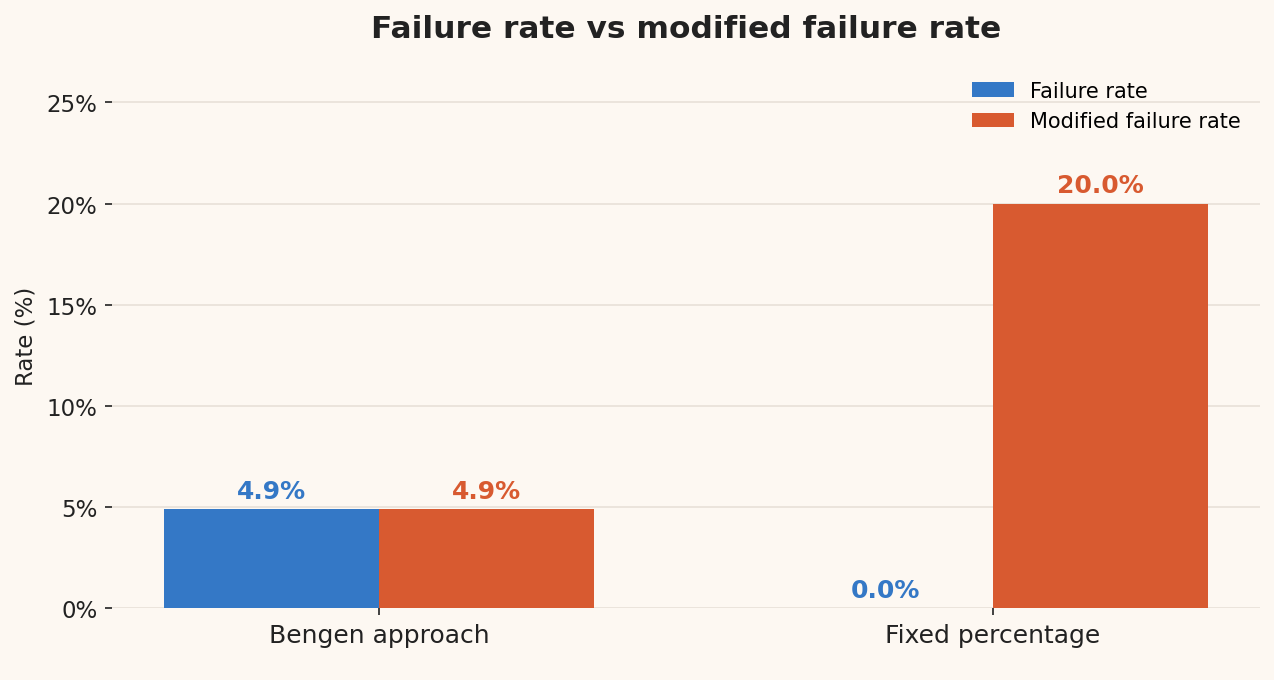
It also isn't an outlier result. In our broader research, built on 10,000 Monte Carlo simulations of 30-year Indian retirements, the constant inflation-adjusted baseline approach carries a 4.9% traditional failure rate, while the forego-inflation rule's traditional failure rate is effectively 0% because it never overdraws a stressed portfolio. Arjun and Kavita's story is simply one concrete draw from that same distribution.
Which retiree would you rather be? Arjun had a simple, predictable rule and a comfortable retirement for most part but with a tumultuous end. Kavita started with less, gave up more of her raises along the way, and never had to worry about the number hitting zero. Neither answer is free of trade-offs, which is exactly the point of the four-dimension framework — spending, stability, savings and sustainability — we introduced in a previous post. We'll keep using real historical case studies like this one, alongside the simulation results, as we work through more dynamic withdrawal strategies in this series.
Disclaimer: Nothing discussed in this article is investment advice of any sort. Always consult with your financial and other advisers before investing.


I believe in your strategy then others and want to follow it , I have retired in July 25 with corpus of 1.14 cr. ( 73 L debt 41 L equity) and withdraw 3% from debt in form of interest after 1 year of retirement in July 26 my corpus is 1.19 cr. ( 76 L debt 43 L equity ) and next five years I will try to manage from my interest Income only not going to touch my equity to grow and debt as well. Your suggestion please.
Thank you for reading. We will not be able to give your feedback on the above.
Can you share the exact excel file – showing this
We are sorry, but you can play around with different numbers using our Retirement Calculator. https://samasthiti.in/retirement-calculator/
Using inflation data, is it possible to see how much Kavita’s real income would have degraded from forgoing the inflation adjustment in years of portfolio decline?
From what I can see roughly in your chart, she’s drawing roughly half of what Arjun is by the end of the 30 year period. Given that Arjun’s withdrawals have grown at inflation, can I assume that Kavita is basically spending half of what she started with in real terms by the end i.e. about ~18K Vs. ~36K. That seems a massive lifestyle decline and I don’t know if it is realistic unless there are alternate sources of income like support from children.
I’ll keep looking through your blogs to see if there’s anything you have suggested which plays with scenarios i.e. a temporary decline in lifestyle but an effort at a catchup when market improve.
Yes, the forego inflation rule does lead to a decline (in real terms) of the withdrawals, as compared to the baseline COLA (cost of living adjustment) withdrawals. But that’s a trade off to make a smaller corpus last longer, or reduce risk of over-withdrawing. There are alternative strategies – some that do very deep cuts, some that dont, its important to look at different dynamic withdrawal strategies and choose a strategy that fits the retiree’s requirements and context. You can read about more dynamic withdrawal strategies from our research below,
https://papers.ssrn.com/sol3/papers.cfm?abstract_id=5381648